
News
Honouring Te Tiriti important for country's future
3 Feb 26

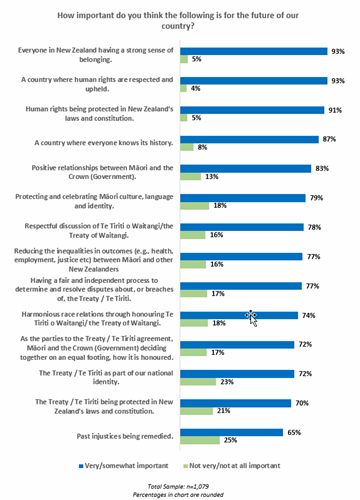
Almost three-quarters of New Zealanders think that honouring Te Tiriti is important for the future of Aotearoa New Zealand.
For the third year, Te Kāhui Tika Tangata Human Rights Commission has surveyed New Zealanders’ awareness, understanding and attitudes to Te Tiriti o Waitangi, human rights and New Zealand’s constitution.
The survey, conducted by Horizon Research, found that a sense of belonging, respect for human rights, and an understanding of our history are overwhelmingly viewed by New Zealanders as important to Aotearoa’s future.
It also highlighted the importance of respectful discussion about Te Tiriti (viewed as important by 78%), positive relationships between Māori and the Crown (83%), and legal and constitutional protection of Te Tiriti (70%).
Conducted by Horizon Research on behalf of the Commission in December 2025, it follows similar surveys in 2024 and 2023.
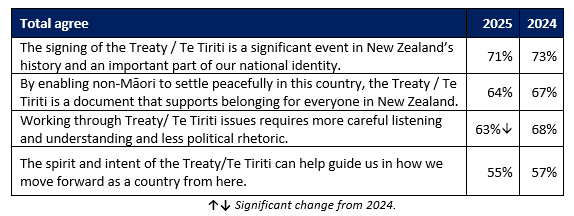
“Many of the results tell a different story to the narrative of division we have been fed over the past two years,” says the Commission's Indigenous Rights Governance Partner, Dayle Takitimu. “The majority of New Zealanders value Māori culture and traditions, care about the real histories of Aotearoa, and want respectful discussions about Te Tiriti.”
In December the United Nations Committee on the Elimination of Racial Discrimination called on New Zealand to uphold Te Tiriti, making a specific recommendation to Government to “take measures to counter misinformation and divisive narratives regarding the Treaty and to promote public understanding of its role in advancing harmony and equality”. The Committee raised concerns about a range of recent government initiatives and warned that weakening Treaty protections “could undermine progress towards reconciliation and risk entrenching historical, structural, and systemic discrimination against Māori”.
“It’s our hope that this data reassures New Zealanders that they are more united than they think,” adds Takitimu. “We want people to share these numbers far and wide, even the areas where we can do better. Let’s have a discussion about how political rhetoric and misinformation moves us, and how we can all have more constructive discussions in future -- tangata whenua and tangata Tiriti.”
What New Zealanders think is important for the future of NZ
- 93% that everyone feels a sense of belonging.
- 91% that human rights are protected in New Zealand’s laws and constitution.
- 78% respectful discussion of Te Tiriti.
- 87% everyone knows the country’s history.
- 83% positive Crown/Māori relationships.
- 79% protecting and celebrating Māori culture, language and identity.
* Horizon Research Human Rights and Te Tiriti/Treaty Issues December 2025
The survey also asked respondents to rate their own level of knowledge around Tiriti issues, as well as their awareness of a range of statements. The findings show that people feel well informed about Te Tiriti and have high levels of awareness of a range of basic Treaty facts.
For example, there is strong awareness of the links between Te Tiriti and human rights, with 88% aware that Te Tiriti relates to people’s human rights, and 80% aware that globally agreed human rights standards recognise and protect the rights of Indigenous peoples. Four in five people are aware that the Waitangi Tribunal has made expert findings on what was agreed to through Te Tiriti.
The Waitangi Tribunal also emerged as the most trusted source of accurate information about Te Tiriti / the Treaty, trusted by 45% of respondents. The Human Rights Commission is named as the fourth most trusted source of accurate information (31%). 17% of respondents said they don’t trust any source.
Of note, areas rating highest in terms of lack of awareness included:
- In relation to the signing of the Declaration of Independence/ He Whakaputanga o te Rangatiratanga in 1835 (with 15% of respondents not at all aware of this)
- That the Waitangi Tribunal has made expert findings that Māori didn’t give up their sovereignty when they signed the Treaty / Te Tiriti (14% not at all aware)
- The tino rangatiratanga guaranteed in the Treaty / Te Tiriti closely aligns with the human right to self-determination (13% not at all aware)
- The fact that current checks and balances don’t stop Parliament from passing laws that breach human rights or Te Tiriti (13% not at all aware)
- The fact that around 500 Rangatira signed Te Tiriti, while 39 signed the English language Treaty (12% not at all aware).
The findings will be used by the Commission to inform its awareness-raising, research and education activities.
More at tikatangata.org.nz
HorizonPoll Online Survey system
and website developed by BEWEB
Copyright © 2010. HorizonPoll incorporating ShapeNZ - Listening to New Zealand

